Why does a waterfront lot in Reynolds cost two or three times what a similar-looking lot goes for a few miles away on Lake Sinclair? The easy answer is golf. Reynolds has five championship courses and a Ritz-Carlton on the water. Cuscowilla has a Coore-Crenshaw course that regularly lands on Georgia's best-course lists. Harbor Club has its own marina and a Weiskopf-Morrish layout. Sinclair, by comparison, reads as the working lake, more residential, fewer clubhouses.
That story is true as far as it goes. It also skips the part that actually shows up in a title search, a dock inspection, or an unexpected notice letter from Georgia Power. The two lakes are managed by the same utility off the same dam system, and they behave nothing alike. One barely moves. The other drops on a schedule you can look up. That difference is not cosmetic. It is priced in.
Same River, Different Job
Lake Oconee and Lake Sinclair are linked by a hydroelectric system built around the Wallace Dam. Georgia Power's own operations documentation for the dam describes Lake Oconee's normal day-to-day range as sitting between 435 feet, which the company defines as full pond, and 433.5 feet. That is the entire operating band. Water gets pumped up into Oconee at night during low-demand hours, then released back down through the dam during peak afternoon demand to generate power, and the whole cycle repeats. Georgia Power's figures put the average daily swing at roughly a foot and a half.
Lake Sinclair sits downstream as the lower reservoir in that same pumped-storage pair. It receives what Oconee releases. And separately from the daily cycle, Sinclair goes through a periodic managed drawdown that has nothing to do with electricity generation and everything to do with shoreline maintenance. Full pool on Sinclair is 340 feet. The most recent scheduled drawdown, announced by Georgia Power last summer, began October 25, 2025, dropping the lake about six inches a day down to a minimum elevation of 335 feet by November 1, with refill starting December 1.
Put the two numbers side by side and the contrast is stark.
| Full pool | Typical operating range | Scheduled low-water event | |
|---|---|---|---|
| Lake Oconee | 435 ft | 433.5–435 ft daily | None on a recurring schedule |
| Lake Sinclair | 340 ft | Several feet of daily peaking fluctuation | Down to roughly 335 ft, on a 3-to-5-year cycle |
Same company. Same watershed. One lake is built to stay close to full almost every day of the year. The other is designed to periodically drop several feet on purpose, for weeks at a time, because that is when the shoreline is exposed enough for residents to actually get permitted work done on docks and seawalls.
What Actually Happens Every Three to Five Years
A Georgia Power environmental affairs representative, Joey Slaughter, explained the pattern plainly to Georgia Outdoor News: drawdowns tied to federal license requirements for dam operations tend to happen close to annually, while the deeper drawdowns aimed at homeowner shoreline maintenance and environmental surveys typically happen on a three-to-five-year interval. Sinclair's fall 2025 event fits that second category.
During that window, the mechanics get real fast. Georgia Power's own notice ahead of the 2025 drawdown told residents that any trailerable watercraft needed to be moved off the lake before the lowering began or stored on a lift inside a boathouse, since boathouses and docks can be left without enough water underneath them once the level drops. Construction equipment and materials have to come off the exposed lakebed between work sessions in case rain pushes the level back up unexpectedly.
None of that happens on Oconee, at least not as a matter of routine. Its daily rhythm is governed by peak power demand, not by a maintenance calendar, so a dock owner there is not planning a boat around a scheduled multi-week drop.
What This Is Actually Worth to a Buyer
This is the part that rarely makes it into a listing description, and it is the part that changes how you should evaluate a shoreline lot on either lake.
On Sinclair, a smart buyer or seller treats the drawdown cycle as a planning tool, not a surprise. If you are eyeing a lot with a seawall that needs work or a dock that is due for repair, find out where that property sits in the three-to-five-year cycle before you assume you can get a contractor on it next spring. Georgia Power's lake levels page publishes current conditions, and permit windows open well ahead of each announced drawdown. A seller who lists during a drawdown and explains the cycle to buyers is in a stronger position than one who lets a buyer assume the low water is permanent or the lake is in trouble. If you already suspect your dock's permit history needs a look before you list, that due diligence is worth handling early, separate from anything the water cycle itself will tell a buyer.
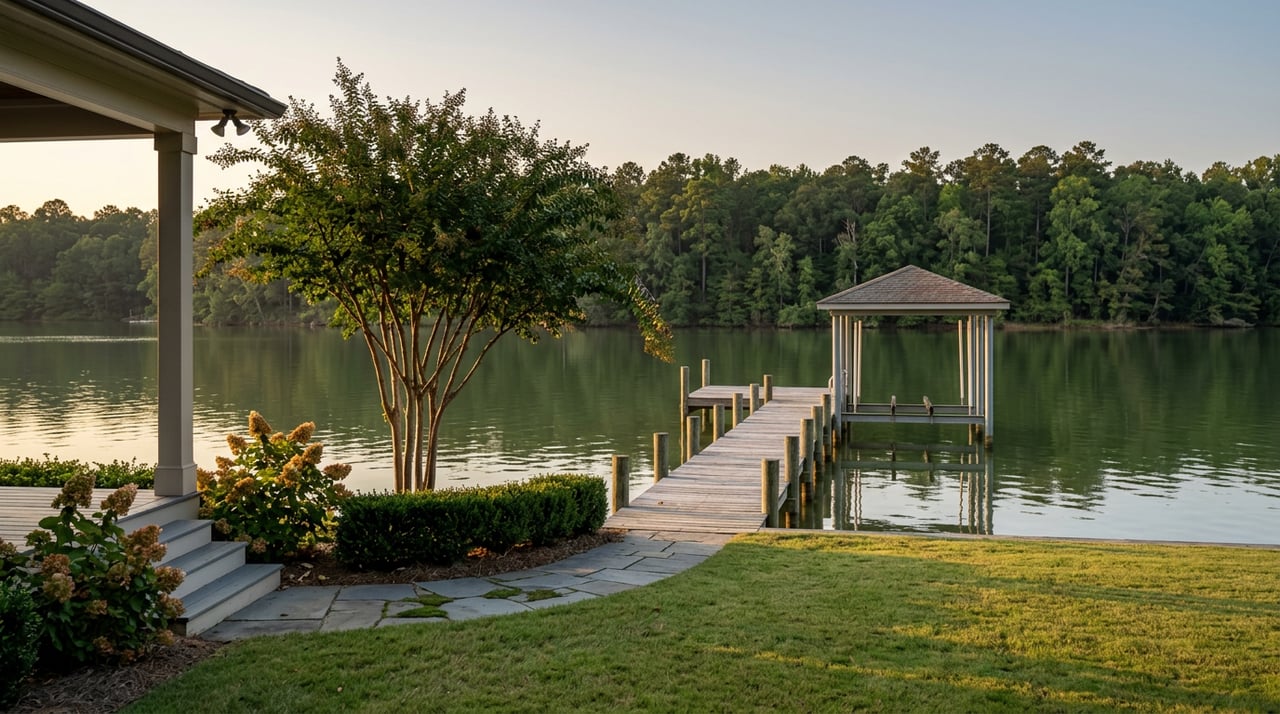
On Oconee, the daily 433.5-to-435-foot band is a genuine, verifiable amenity, not just marketing language. A property with a properly permitted dock stays usable across nearly the entire calendar, without an owner needing to plan around a multi-week low-water stretch. For a buyer counting on rental income around Masters Week in Augusta or planning to keep a boat in the water year-round rather than trailering it home every winter, that consistency has real dollar value, separate from whichever golf course sits behind the house.
Current 2026 listing data across Oconee's communities shows the premium holding across very different amenity packages. Waterfront homes inside Reynolds are averaging $1.8 million and up. Harbor Club, Cuscowilla, and Traditions at Carey Station price from around $500,000 up toward $3 million, with the most active band for Oconee waterfront sitting between $800,000 and $2.5 million. Those are three different clubs, three different architects, three different membership structures, and the price floor holds up across all of them. Golf pedigree explains some of that spread between communities. It does not explain why the entire lake trades at a premium over a neighboring reservoir with its own golf courses and its own gated communities. The water level mechanism is the piece of that story a portal search will not show you.
A Few Questions Worth Asking Before You Write an Offer
Does Lake Oconee ever go through a drawdown of its own? Georgia Power's operations documentation for the Wallace Dam describes Oconee's normal range as a daily pumped-storage cycle rather than a periodic maintenance drawdown. Extreme drought conditions can still affect any reservoir, but Oconee is not built around a scheduled multi-week low-water event the way Sinclair is.
How do I find out where Sinclair's next drawdown falls in the cycle? Georgia Power's lake levels page tracks current conditions, and the company issues public notice ahead of each scheduled event, typically with permit applications opening weeks in advance.
Does a pending or recent drawdown affect financing or appraisal? It can affect timing more than valuation. A lender's appraiser evaluating dock condition during a drawdown window should understand the cycle is scheduled and temporary, which is one more reason a seller benefits from documenting where a property sits in that cycle rather than leaving a buyer to guess.
Golf will always be part of the Lake Oconee sales pitch, and it is a fair one. But if you are comparing two waterfront lots and only one of them sits on a lake engineered to hold nearly full pool three hundred and sixty-some days a year, that is worth knowing before the number on the offer sheet, not after.
If you are weighing a lot on Oconee against one on Sinclair, or trying to figure out where a specific property falls in either lake's water cycle, Traci Nelson can walk through the shoreline specifics with you and help you Find Your Lake Lifestyle.
This article is general information, not legal, tax or financial advice. Consult a qualified professional about your situation.